Joy is Irreplaceable

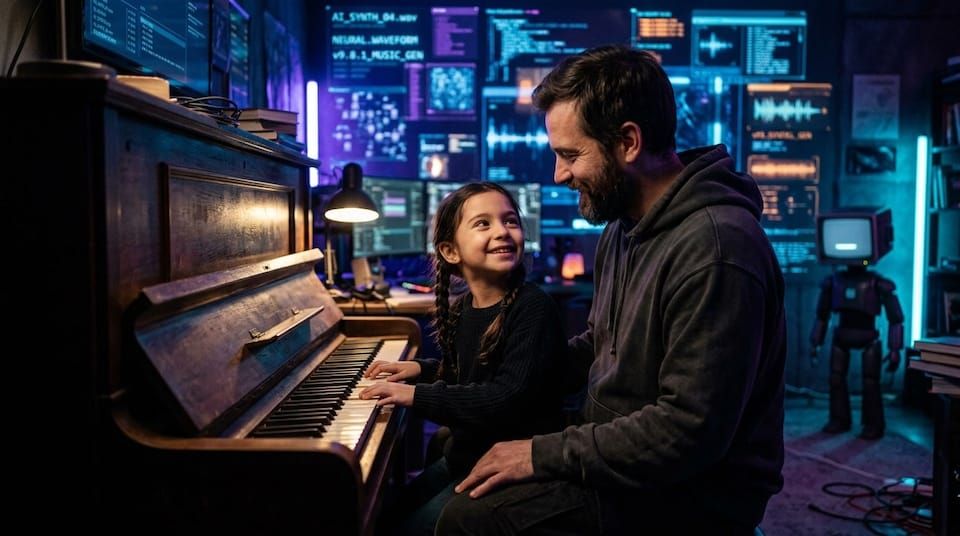
Today is April 23rd — National Sovereignty and Children's Day. A day dedicated to children. Though if we are honest, it is really a day that reminds us every other day belongs to them too.
As parents living through the rise of AI, we keep hearing the same question. Sometimes we ask it ourselves, sometimes someone else says it out loud at dinner: "We managed to get by somehow — but what will our children do?"
It is a fair question. It deserves more than a shrug.
What AI actually changed
Large language models did not just automate tasks. They collapsed the distance between knowing and doing.
Writing, translating, summarising, coding, researching, designing — things that used to take years of deliberate practice to do competently can now be done passably by someone with no training and a well-written prompt. The floor rose. Dramatically.
That is not a bad thing. But it reshapes what it means to be skilled. If a machine can produce an acceptable first draft of almost anything, then the value of producing an acceptable first draft of anything drops. The skills that remain valuable are the ones the machine cannot replicate — judgment, taste, lived experience, the ability to know what is worth making in the first place.
We watched this happen in real time. Translation — a career built on deep cultural fluency — became a commodity overnight. Copywriting followed. Visual design is mid-collapse. Code is next, or already there depending on who you ask.
Every generation faces technological displacement. Ours is just faster.
No escape, only adaptation
We do not have the luxury of opting out. Not as professionals, and certainly not as parents.
The instinct to protect our children from this is understandable. But protection that looks like avoidance does not work. Technology does not wait for anyone to be ready. We either learn to stand beside it or we get dragged behind it.
That means we go first. We face the discomfort of learning tools that make parts of our own expertise feel less special. We sit with the anxiety of not knowing which skills will still matter in five years. We do this so that when our children look at us, they see someone who adapted — not someone who hid.
Preparing our children for a world shaped by AI starts with us weathering the storm ourselves.
The one language that did not lose its meaning
Since large language models entered my life, I have watched the value of nearly every language I know shift. My mother tongue included. Fluency in a language — any language — is no longer the differentiator it was.
But there is one language that has not moved. Music. The language of vibrations. You could call it the language of God.
Yes, AI generates music now. It produces tracks, composes melodies, mimics styles. That is not the point.
The point is what happens when a child sits at a piano and presses a key and hears it. The point is the feeling in your fingers when you land a chord progression you have been struggling with for weeks. The point is the look on a five-year-old's face when she plays a song from memory for the first time and knows — without anyone telling her — that she did something real.
That joy is not outsourceable. It does not live in the output. It lives in the doing.
AI can generate a painting, but it cannot feel the brush. It can write a poem, but it cannot feel the weight of choosing one word over another. It can produce a song, but it cannot feel the vibration travel through your hands.
Music is one of the oldest things we have. It predates writing, predates agriculture, predates civilisation. It has survived every technological revolution so far — not because it is useful, but because it is human. Making music is not a skill that competes with AI. It is an experience that exists outside the competition entirely.
What we can give them
We cannot predict which jobs will exist in twenty years. We cannot guarantee that the degrees we choose for our children will still be relevant. We cannot control the pace of change.
But we can give them something that does not depreciate.
Teaching a child to play an instrument is not career advice. It is something deeper — a connection to a language that has never lost its meaning and never will. A form of expression that no model can feel on their behalf. A joy that belongs entirely to the person making it.
In a world where so much is being optimised, automated, and abstracted away — the ability to create something with your own hands, to feel it resonate, to share it with someone sitting next to you — that might be one of the most valuable things we can pass on.
Not because it is useful. Because it is irreplaceable.
Drafted by me, shaped by Claude.